In this episode, Jessie Henderson from Salt Chamber, Inc. compares Himalayan salt tiles, prefabricated salt panels, and natural salt boulders. She explains how their appearance, installation methods, portability, shipping, and labor costs differ, and shares examples of projects that combine all three.
John Maher: Welcome to the Salt Chamber Podcast. I'm John Maher. Today I'm joined by Jessie Henderson, Senior Salt Therapy Consultant at Salt Chamber Inc. Salt Chamber specializes in designing and building salt therapy spaces and providing halo therapy equipment, Himalayan salt decor, training and ongoing support for spas, resorts, wellness centers, and more. Today we're talking about Himalayan salt tiles versus salt panels and salt boulders. Welcome, Jesse.
Jessie Henderson: Thank you, John. Great to be here. Looking forward to talking about some Himalayan salt today.
John: Yeah, thanks. Jesse, for someone unfamiliar with some of the options, how would you explain the basic differences between Himalayan salt tiles or bricks, prefabricated salt panels and natural salt rocks or boulders?
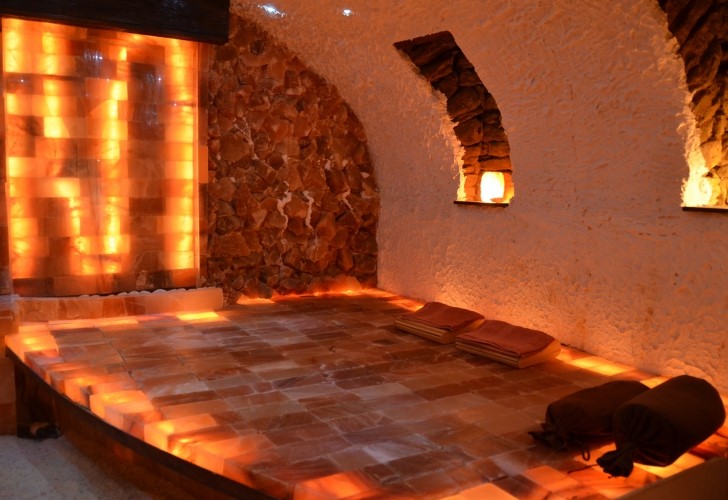
Jessie: Absolutely. So first thing to note is they are all Himalayan salt. They all come from the Himalayan salt mines. They are cut differently or formed differently. The tiles -- most people will call them tiles, we call them bricks because they look exactly like a brick -- they can be cut in different shapes with different companies. Vendors offer 12x12s or 8x4x1, 8x4x2, but they are a smooth surface where you will often see hues and striations, whether it's white or pink. White is a little bit more difficult to source from the mines, so they're often a little more expensive, but it is all true, pure Himalayan salt. So the bricks or tiles come smooth and precut, easier to build more of a brick wall style.
The panels [are made from materials] that we procure in big vats of chunks or grain or pebbles, like the size of a date, if you will. We construct these panels [using resin to glue the chunks together], with all kinds of different configurations of chunky, bumpy, and coarse grain salt, so it looks a little more natural. And they often come in a precut tile, like a 22x22 inch or a 2 foot by 4 foot. These often have a little bit easier application for the wall as well.
Finally, the boulders, they are just as they suggest. It's a big rock chunk, but they're not rocks, they're salt. So it would be more like if you've seen those Himalayan salt lamps in stores or in your home. These do not have a hole drilled with a light in them. They come as the raw boulder. So some people choose to flatback them and put them up on the wall in some sort of pattern, making it look more like a natural cave. And some people like to just throw them in the corners of their room, maybe even throw some rope lighting behind them.
Jessie: So there's a lot of different applications of Himalayan salt that you can put on and around your walls.
John: And what is generally the best option for a smooth architectural feature wall or one that creates a more textured cave-like appearance and which works best as a dramatic natural accent?
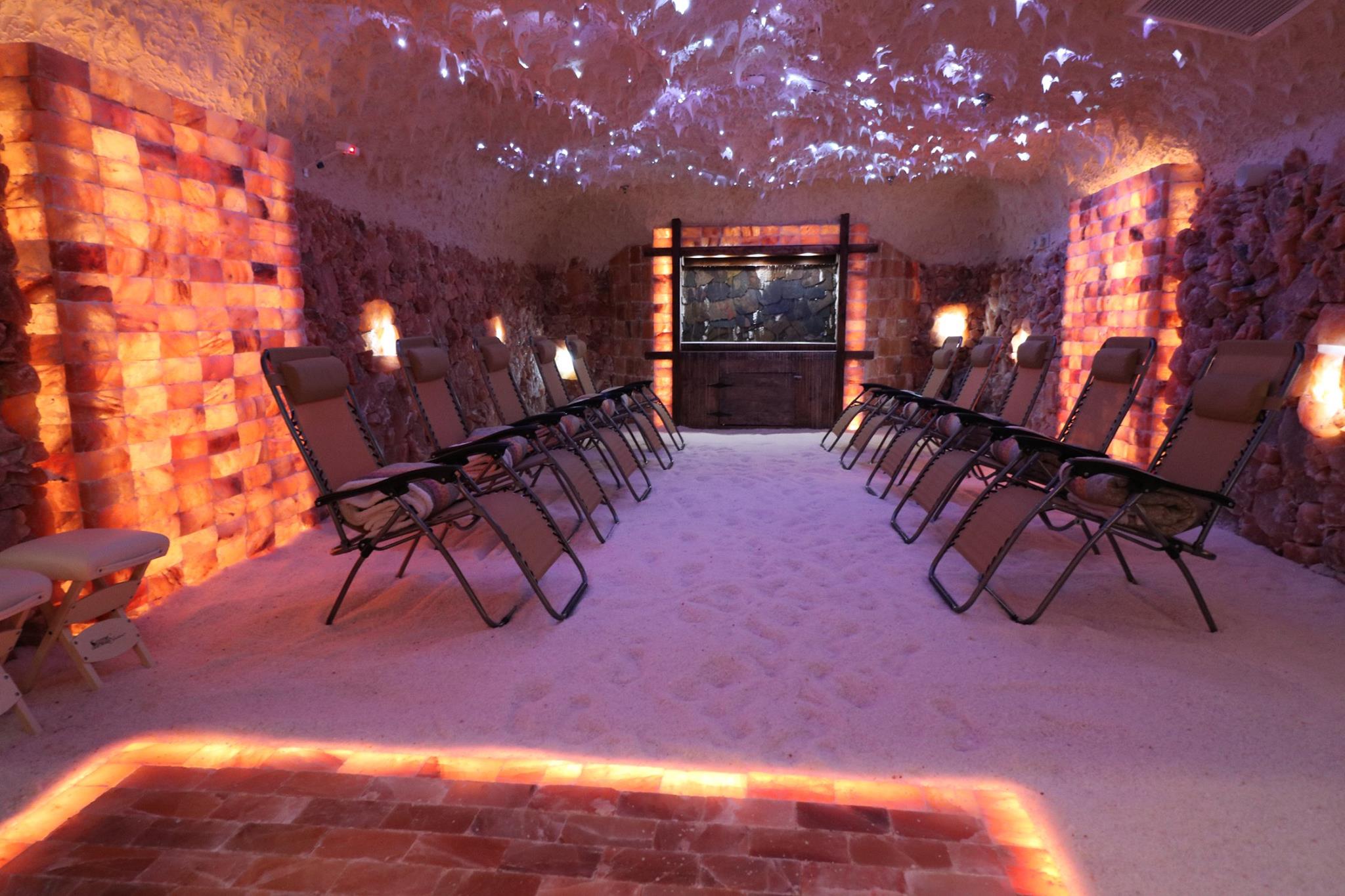
Jessie: I would say the more cave-like, dramatic, natural would be a combination of the panels. The bumpier, chunkier you go, the better, and you can lead that into boulders and then floor salt as well. So you feel like you're walking into a different environment and it's more experiential. It can cost a little bit more, of course, because Himalayan salt goes on weight and the bigger boulders, the bigger bags of floor salt, the heavier the weight on the panels, you'll pay a little bit more in shipping and it might be a little bit more for installation. The more smooth, architectural, almost like wellness center, med center style, I just want a big beautiful backlit wall. I want to stay really elegant and simple and have that beautification. It would be the bricks, the tiles. Most things are precut, they're very smooth, and your contractor would put them up in a smooth fashion, all up on maybe one wall or two walls, backlit or not.
John: And how do these different options compare in terms of installation difficulty, construction time, lighting possibilities, customization, and the ability to maybe move or modify the installation later?
Jessie: It's a very great question. We do have a lot of clients that need that answered because some are leasing or renting a space and they might be moving in a year or two. Often we lead them more toward loose boulders, floor salt that can be scooped up and put in buckets and taken away. The salt panels, the bumpy, chunky, coarse, they look more natural. They come in a square or a rectangle. Those are often applied very simply with four screws straight into the wall or straight into spacers with back lighting. You could undo those screws and take those panels with you if you had to move. So it's a little more versatile for a space that you might not be permanently staying at, as well as construction costs. Those things don't often take as long to put up unless you're doing custom cutting. If they want a mountain range made out of panels, you can have your contractor cut that and put them together very specifically.
It could take a little longer if you're doing a custom design. Otherwise, we put those panels up with screws. It's a much shorter construction time. If you're going bricks, it's a more permanent structure. You better be staying there or you better be prepared to leave the brick wall. You can eventually try to take it down, but the bricks are individually glued. So it's going to be a much more solid substrate, a full permanent wall, if you will. So if you're using the tiles, the precut tiles, 8 inch by 4 inch by 1, or 12 inch by 12 inch, and they are individually glued throughout a whole wall substrate, you will probably leave that there and it's going to take a lot longer for contractors to build that out.
John: Okay. How should buyers compare their total installed costs rather than looking only at the price of the salt materials themselves?
Jessie: Yeah, it's a very important aspect. Even when shipping this stuff, you could go with maybe a cheaper vendor, but you might not have any insurance on the shipping. You might not have any guarantees or any customer support. So I always recommend, search around, find a good vendor. We've been in this over 15 years. We really have a solid vendor we work with at the Himalayan salt mines. We know what we're getting and the quality of it. And likewise, we pay to procure that, to get it in the states to make sure it's insured while it's shipping to you. We have that backing and the support and the guidance when installation comes to be. If you just order bricks somewhere, they might all come broken and then you're out of luck and you don't have anybody to help you and support you and put that up the right way as well.
So it's a lot about how you're getting them, which vendor you're getting them from, and who's willing to help you throughout the process that's going to save you money and save you time. Likewise, if your bricks are all cut goofy, your contractor's going to have a lot of work to make sure those are smooth and fitting exactly together. It could cost you hours more in installation. So we work with our clients to make sure they're not getting [ripped off]. They're getting an appropriate quote from a contractor. They're bidding out the project appropriately. And likewise, we've spent the time and money and energy to make sure this gets to them completed, nicely cut, ready to go for installation.
John: And can salt tiles, panels and boulders be combined into the same project? And what are some examples of how salt chamber has used a kind of hybrid approach to create a really distinctive space?
Jessie: Yeah, we have quite a few actually. And on our website, if you request, I can send you the whole portfolio as well, but there's been so many really cool rooms. We've done over 5,000 rooms now and they're all very different, super unique. One of them decided to do an entire wall mural of mountains. It was a mountain range with the panels, the bumpy, chunky panels formed in resin. So we created a grid, and when it got there, it allowed the contractor to put it up, and it was a beautiful mountain range. Likewise, they used backlit bricks on these walls back here and boulders along the base of the wall. And then they used a starry sky and different substrates to create more of a cave feel. We've also had people that inlay the bricks in the wall and then go down into half-cut boulders and then go down into floor salt.
Other walls could be complete panels, bumpy, chunky, coarse panels, not back lit. And it also looks kind of like a cave or a salt mine if they use beams and support things around. So we've created some really interesting spaces with a lot of different modalities. You don't have to just use bricks or just use panels.
John: All right, well, that's really great information, Jessie. Thanks again for speaking with me today.
Jessie: Of course. Thanks for having me on.
John: And for more information about Salt Chamber, you can visit the website at saltchamberinc.com or call 561-556-3322.

Leo Tonkin, with a decade of deep expertise in salt therapy, initiated SALT Chamber, a leading entity in the domain of salt therapy products and decor. As the inaugural Chairman of the Salt Therapy Association and Chair of the Respiratory Wellness Initiative from the Global Wellness Institute, he has played a pivotal role in broadening the accessibility and recognition of salt therapy globally. His commitment to developing advanced technology and educating the public on the benefits of salt therapy has solidified his position as a key figure in the industry, enhancing its credibility and trustworthiness.