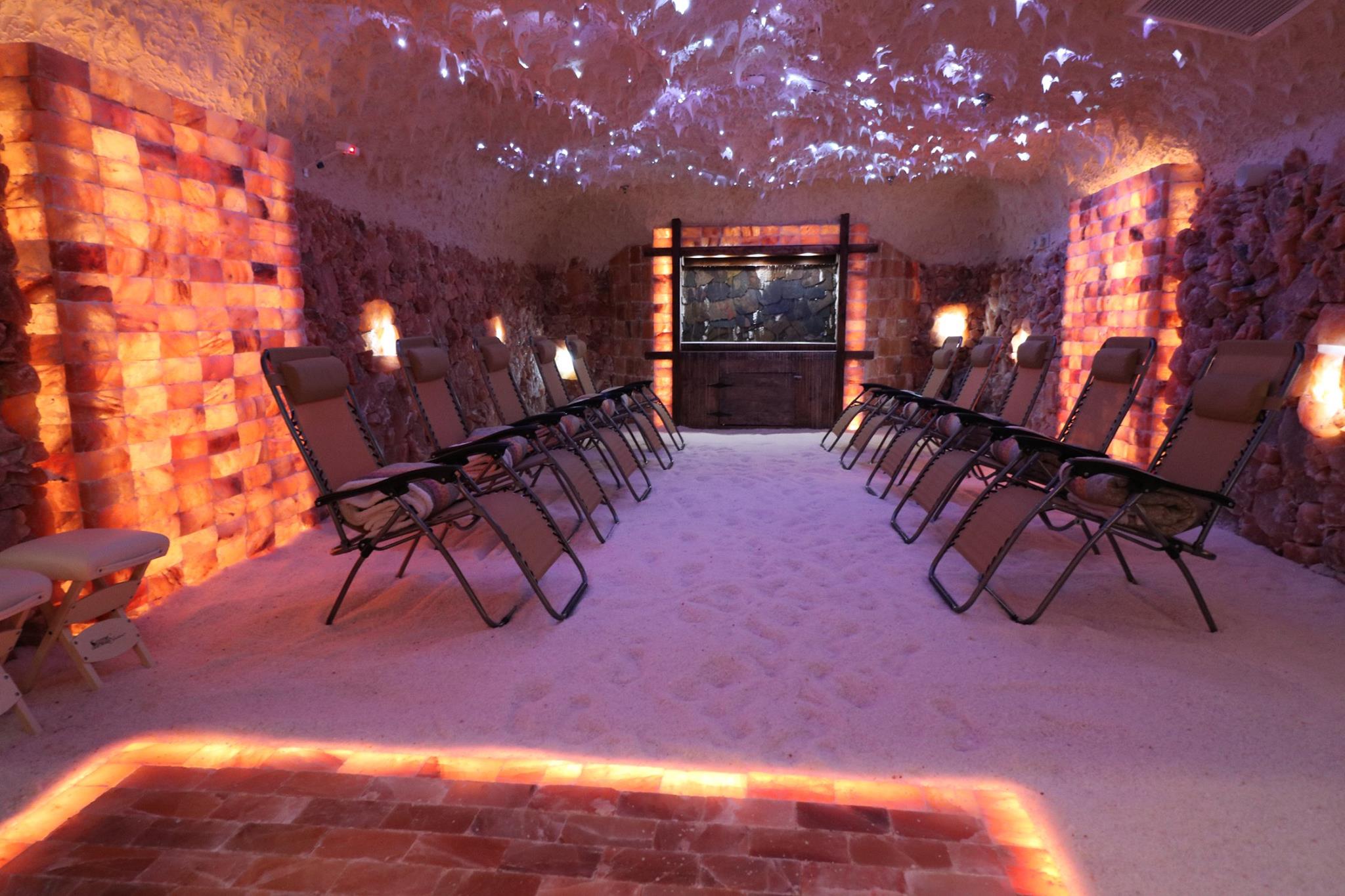
In this episode, Jessie Henderson from Salt Chamber, Inc. discusses how to select and apply salt adhesive for a Himalayan salt wall. She covers clear adhesive for backlighting, smooth surface preparation, humidity during curing, base support, and the installation mistakes Salt Chamber helps contractors avoid.
John Maher: Welcome to the Salt Chamber Podcast. I'm John Maher, and today I'm joined by Jessie Henderson, Senior Salt Therapy Consultant at Salt Chamber, Inc. Salt Chamber specializes in designing and building salt therapy spaces and providing halo therapy equipment, Himalayan salt decor, training and ongoing support for spas, resorts, wellness centers, and more. Jesse, welcome to the podcast.
Jessie Henderson: Thanks, John. Excited to be here. Looking forward to talking today.
John: Yeah, thanks. Jesse, today we are talking about best practices when using salt adhesive for a salt wall. So when you're building a salt wall, when is adhesive the best installation method and when might things like metal framing or another adhesive free system make the most sense?
Jessie: Yep, that's a great question. And I do believe there are a few companies out there with their own proprietary methods. Ours uses a natural eco-adhesive with low viscosity, it's the low scent. So you really want to make sure that it's safe for your clientele and very strong and will adhere the bricks to...whether it's a clear sheet of acrylic or a solid substrate in the back wall. But yeah, it's really for bricks with the adhesive. We do also offer panels. It's a different kind of construction of Himalayan salt formed in resin in a hard panel. Those only require screws. So there are different applications available for [adhering] salt to a wall.
John: And when is it important to use an adhesive specifically selected for Himalayan salt rather than ordinary construction adhesive or mortar or tile setting types of products?
Jessie: Yep. Salt is a natural mineral of the earth. It's not a brick, it's not a stone. So mortar is used more in those instances, but if you're going to be backlighting this wall, you have to have a see-through, clear adhesive. And again, it really has to be that low scent, eco-friendly, making sure that your clientele is not going to have a heavy smell in the room when they're locked in doing these salt sessions in a fully enclosed area. So really preparing that environment, making sure the bricks are wiped off and smooth, and making sure the surface you're gluing them to is just as important as using an eco-adhesive that's natural or low odor.
John: Right. So you don't want to use an adhesive that doesn't let the light through because then you end up with these very, very sharp lines in between the bricks, right?
Jessie: Yep. Just like mortar. There's certain instances where we do use this for boulders or bricks. Maybe someone's building a fireplace in their salt spa or in their room, but they want to use Himalayan salt. If you're not backlighting it, you can use a mortar. There's certain applications where it's warranted, but for the most part, we recommend this eco-friendly adhesive.
John: How should the wall surface and the salt bricks themselves be prepared before applying salt adhesive, especially when it comes to cleanliness, dryness, and the type of backing material?
Jessie: Yep. Essentially, it should be smooth. A lot of people think it should be scored or rough. Again, this isn't a brick. You know how bricks are? They have that kind of crumbly [texture] on the back. This is a very smooth salt brick. Likewise, what happens to salt when you get it wet? It dissolves, it goes away. So you can wipe these clean, but you really want to make sure it's not with a lot of moisture. If you do, make sure you dry them right away. So it should be a smooth back of the brick and it should be a smooth, clean surface that you're applying it to. Most of the time we recommend acrylic. We recommend a clear acrylic that you're gluing the bricks to. Both are smooth surfaces and we've found a lot of success with the adhesive.
When this is applied, the biggest factor is also humidity. A lot of people think, "oh, I need this completely humidity free". The eco-adhesive might not cure fully and this could lead to bricks falling off or a wall falling down. So you really want to make sure and, per the adhesive manufacturer's advice, to be about 50 to 65% relative humidity during the build out to make sure that curing happens for both of those smooth surfaces.
John: Okay. And how much adhesive should be used? How is it applied? What curing or waiting time should installers allow before finishing or lighting the wall?
Jessie: Yep, absolutely. The lighting of the wall will happen before the bricks go up because the lighting will be behind it and usually there's a surface in front of them that's been drilled in. It's a permanent structure and then we're gluing the bricks on. You will generally start at the bottom, just like a brick wall you would build, even with mortar, and you're building the wall how you want it. You would wait, maybe go about four feet and wait a few hours. You really want to make sure that that does cure and that your room temperature is neutral, like 68 to 70 something with low humidity -- 50s, 60s -- to make sure that that glue actually cures. And then you can continue building your wall up.
It might take a day, it might take a few days. It depends on the wall size and also how much cutting of the bricks has to happen. And that goes to getting a good supplier and making sure the bricks are uniform sizes so they fit nicely together.
John: What makes Salt Chamber's salt adhesive different and what are some of the common installation failures that can occur when someone uses the wrong product or skips the recommended steps?
Jessie: Yeah, like I mentioned, a salt wall can fall down. It doesn't happen very often, but we have gotten a few calls where they had no idea of the humidity [that the room should be in during curing]. One of them had fans going and dehumidifiers at the same time, and there was no humidity in the air whatsoever, so therefore it wouldn't have mattered what adhesive they used, it was going to not cure.
[Editor's Note: The most common cause of a wall failure is too much moisture around the bricks, either from cutting on a wet tile saw or from excessive humidity and condensation in the room. This causes the salt surface that the adhesive is bonded with to dissolve/degrade and the bond fails.]
Also, we've mentioned this before, but the brick wall, when it's back lit, has to come out about five and a half inches. If you don't have those bricks at the base supported by the floor or by a footer, they might slide down during the curing process and then it's very difficult to start over, because some are adhered and some are not.
Again, these are very minimal mistakes, and working with someone like Salt Chamber, we'll walk you through this. A little handholding goes a long way. We can get on a phone with your contractor, we can make sure you have the environment in the right manner, the right humidity levels, and that they're taking the time to get the brick wall built out the correct way the first time. Our adhesive really, again, is low odor, eco-friendly.
There are a few others that might work, but this has been proven and tested for about 15 years. We don't really see any issues unless it was kind of user error and somebody had no humidity in the room or their contractor used way too much adhesive. We recommend five dots on the back of the brick. It's a very simple application. If you're smothering it everywhere, they could be sliding, shifting, might not stick fully. So a couple different things, but really we walk you through to make sure it's a done deal. It's a good process.
John: All right, well, that's really great information, Jessie. Thanks again for speaking with me today.
Jessie: Of course. Thanks for having me.
John: And for more information about Salt Chamber, you can visit the website at saltchamberinc.com or call 561-556-3322.

Leo Tonkin, with a decade of deep expertise in salt therapy, initiated SALT Chamber, a leading entity in the domain of salt therapy products and decor. As the inaugural Chairman of the Salt Therapy Association and Chair of the Respiratory Wellness Initiative from the Global Wellness Institute, he has played a pivotal role in broadening the accessibility and recognition of salt therapy globally. His commitment to developing advanced technology and educating the public on the benefits of salt therapy has solidified his position as a key figure in the industry, enhancing its credibility and trustworthiness.