In this episode, Jessie Henderson from Salt Chamber, Inc. explains how halogenerators distinguish active salt therapy from decorative salt rooms. She discusses the salt used in the equipment, room sizing, session settings, airflow, and questions to ask a salt room provider.
John Maher: Welcome to the Salt Chamber Podcast. I'm John Maher, and today I'm joined by Jessie Henderson, Senior Salt Therapy Consultant at Salt Chamber Inc. Salt Chamber specializes in designing and building salt therapy spaces and providing halo therapy equipment, Himalayan salt decor, training, and ongoing support for spas, resorts, wellness centers, and more. Today we're talking about active salt therapy, how a halo generator turns a salt room into a halo therapy room. Welcome, Jesse.
Jessie Henderson: Thank you for having me today. I'm excited to talk about this.
John: Absolutely. Jesse, what is active salt therapy and how does it differ from simply relaxing in a passive room that's decorated with Himalayan salt walls, bricks, or other salt features?
Jessie: Well, I'm very glad you asked this question because it is a huge difference, and we do get this question often from our clients. Active salt therapy is when you are being introduced to pure sodium chloride that's been broken down into super fine particles, put through the air, through your skin, and into the deepest parts of your respiratory tract. So you are therefore able to detox, kick things out like mucus, histamines, bacteria, even take care of some skin issues like psoriasis, eczema, rosacea, acne. The true active pushing of pure salt through the air into your body and into your skin is what active salt therapy is, and that involves a halo generator.
John: Where did salt therapy come from? Is this something that we recognized in Mediterranean countries that were right by the ocean and those people that are constantly breathing in salt air, they had a little bit of a different health experience than other people? How was this halo therapy or salt therapy discovered?
Jessie: Yeah, it actually stems way back from the Polish salt mines. And you'd think mine workers, they would come out all dusty and dirty and not healthy and their lungs would be terrible because they were breathing that coal in all day. Salt miners were not sick, were not having any issues. It was like this miraculous miracle of health when they were down deep in these mines, thousands of feet down all day.
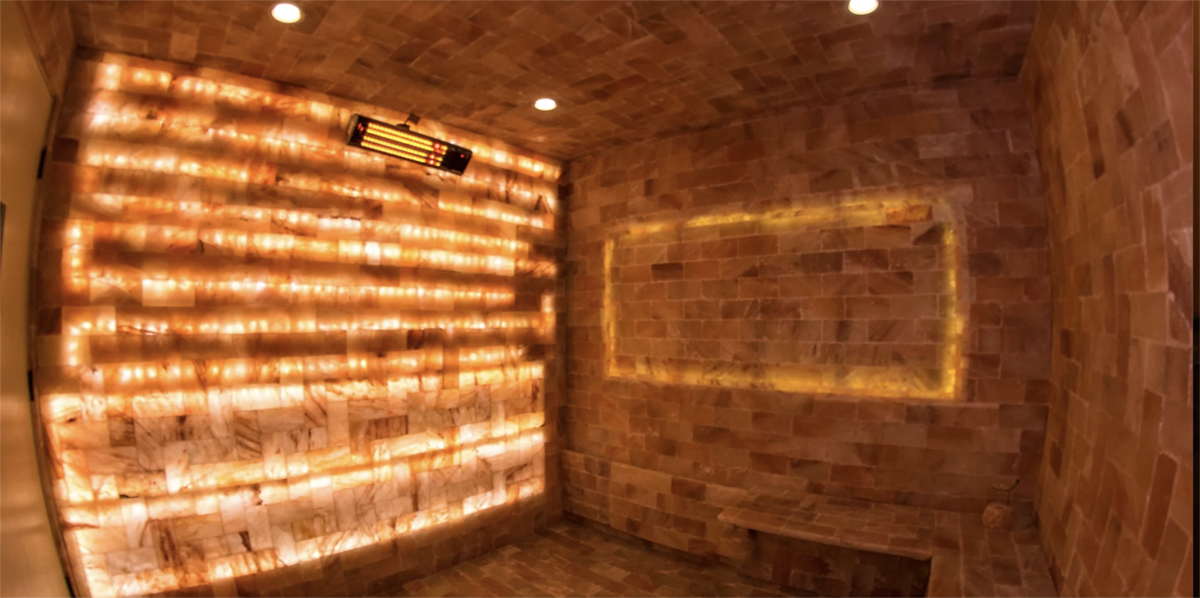
It actually started shortly thereafter as speleotherapy. And again, they performed these salt sessions deep down in the mines and it was more of a form of wet salt therapy or even damp being in that area. We have since been trying to recreate active true salt therapy above the ground. Obviously it will never be that exact session, deep down, thousands of feet below the ground in a cave, but we do our best with our Himalayan salt decor. Although people love to see that decor all throughout a room or a salt cave above the ground in a facility, it is truly the halo generator that is blowing that pure salt through the air that helps with all of the antibacterial, anti-inflammatory lung and skin health.
John: So tell me a little bit more about that. And what exactly does a halo generator do from grinding the salt into microscopic particles to dispersing the dry salt aerosol into the air?
Jessie: Yeah. This machine was created, it's called a halo generator. Halo is Greek for salt. So it's basically a salt generator. It is made with the purpose of grinding pure salt, almost like table salt. It's that size, and it pulls it down through a blade and obliterates it into this pure, purifying particles, finer than dust, 0.3 to 1 microns in most cases, and puts it through the air, finer than dust. So therefore it can float on the air. It can get to the humans, get on their skin and through the first layer of the epidermis as well as deep into the respiratory tract. So that means absolutely everywhere. I've seen kids helped with ear infections or not have to get tubes, sinus infections, things behind the eyes and swelling and pressure, things all the way deep down into the lungs, even chronic bronchitis and long COVID, all of these things, chronic cough, asthma, allergies, you name it.
Jessie: Salt is a high antibacterial anti-inflammatory agent and it acts as a toothbrush for the lungs. So the halo generator is needed, the right size for the right space, to push this salt through the air and reach the people.
John: Why does active halo therapy use pure grade sodium chloride rather than Himalayan salt or sea salt or the decorative salt that you might see in one of these salt chambers or salt rooms that you go into?
Jessie: Yep. And we get that question often as well and it's important. Your lungs are different than your skin. You might soak in a bath with Himalayan salt or eat it on your food. That goes into your digestive tract and gets soaked through the skin in those instances. It's perfectly fine and safe and it's actually very healthy to remineralize the body, but Himalayan salt has 84 trace minerals, not just pure sodium chloride. And although they are trace minerals, these are not necessarily things you want to be breathing into your lungs. They could cause an unsafe environment internally in your body. So, same thing with sea salt. There's all kinds of stuff in sea salt. It's from the sea, from the ocean. So we generally recommend and offer pure halo salt. It's been stripped pure to its purest form, 99.99% pure sodium chloride. We know it's safe, it's proven safe. People cannot be allergic to this kind of salt. It is quite literally pure sodium chloride that is meant to cleanse and help the body in the right way.
John: How are factors like room size, session length, airflow, salt concentration, and maybe even the number of participants in a room considered when you're programming a halo generator?
Jessie: Yeah. First and foremost, not all halo generators are created equal. There's a few on the market. You want to make sure that it is programmable and that you can set the salt concentration levels as well as the fan speed as well as the session length. It's very important for the size of the room to match the power of the halo generator. For instance, we have three different models. One is great for a booth or a small little room, 36 square feet or less, even inside of a sauna potentially. And one is good for a hundred square feet or less. More of a commercial grade, has a fan, has to be mounted outside the room blowing salt in, but it can reach up to a hundred square feet with its power and CFM. The final one is our largest one. It can go on any room up to 400 square feet.
Again, matching the size space with the size halo generator and its power, fan speed and CFM levels are very important to make sure each client that's sitting in the room gets the allotted and correct amount of salt to them. These clients should experience kind of a taste, a sense. If they shine their light in a dark room, they should see these particles floating on the air. If they visit a salt room and you don't see, taste or feel salt through the air, you might just be sitting in a room with Himalayan salt on the walls, which is fine for relaxation, meditation, beautification, relaxing. But if you want actual health for your lungs and skin, you have to see, taste, and feel that salt coming through the air.
Lastly, with that, you mentioned airflow and balanced air. It's extremely important. Most salt rooms that we work on have to have some sort of air coming in and an exhaust on the opposite side of the room. So you can have a balanced airflow and the salt can circulate through as well as cleansing the space after each session.
John: Are there any dangers if you have the salt concentration too high in a room like this? And so is the halo generator therefore very important to make sure that you have that right salt concentration?
Jessie: It is very important. I will tell you it's not precise. There's no one right setting on your machine. And I even used to have clients at my spas that would go stand right in front of the hole and they wanted to get blasted with the salt. You can't really get too much salt. We used to limit our clients to two sessions a day. You can get a little dried out, just as with anything. When you get a massage, they ask you to drink a glass of water afterwards. You want to make sure that your body is staying in optimal limits. But no, the halo generator has the settings to go very high. I don't think it would ever cause any extreme damage to the clients if you kept it at the highest levels. We do that for safety purposes, but we also train our clients whenever we're building a salt room for optimal levels of salt and fan speed when they're setting up their room.
John: You mentioned the taste in the air. What should consumers and business owners look for to kind of confirm that a salt room is providing properly managed active halo therapy rather than only a passive salt room experience?
Jessie: Yeah. As I said, you can ask the owners, do you have a halo generator? That's just first and foremost, is this a true salt room? Do you have a halo generator? That is the machine that causes the salt to go through the air. If they say no, or it's a meditation or relaxation room or just has a salt wall, that's perfectly fine for meditation, relaxation, grounding, but it's not going to do anything for your lungs or skin. So important to ask the questions, is this true active halo therapy or salt therapy? You can also sit in your chair and sense it. You might hear a machine. It might be putting salt through the air and you will hear it. And like I said, after maybe 10, 15 minutes, if you shined your light in there, you should be able to see super fine crystallized particles floating on the air.
Jessie: If you can't, the halo generator could be clogged and not putting out salt. The airflow might not be proper in that room, properly set up. And likewise, they might not have a halo generator. So just making sure that you can sense it, see it, and you've talked to the owners about it being true salt therapy.
John: All right, well, that's really great information Jessie. Thanks again for speaking with me today.
Jessie: Of course. Thanks for having me.
John: And for more information about Salt Chamber, you can visit the website at saltchamberinc.com or call 561-556-3322.

Leo Tonkin, with a decade of deep expertise in salt therapy, initiated SALT Chamber, a leading entity in the domain of salt therapy products and decor. As the inaugural Chairman of the Salt Therapy Association and Chair of the Respiratory Wellness Initiative from the Global Wellness Institute, he has played a pivotal role in broadening the accessibility and recognition of salt therapy globally. His commitment to developing advanced technology and educating the public on the benefits of salt therapy has solidified his position as a key figure in the industry, enhancing its credibility and trustworthiness.